Rethinking Workforce Strategy: 3 Principles for Better Business Performance

authors are vetted experts in their fields and write on topics in which they are extremely knowledgeable. All of our content is peer reviewed and validated by world-class professionals.


Enterprises are under increasing pressure to secure the workforce capacity and skills their businesses need. But meeting staffing targets doesn’t necessarily resolve the business condition creating that demand. Even when positions are filled, backlogs and capacity constraints can persist, and service levels can remain under pressure.
At the same time, workforce requirements are changing rapidly. The World Economic Forum reports that 39% of core workforce skills are expected to change by 2030, driven in no small part by AI, while 63% of employers identify skills gaps as a barrier to business transformation. Together, these pressures require leaders to look beyond the requisition to understand what is actually causing the workforce demand.
When workforce performance issues surface, they often come back to the procurement team as just another set of staffing requests: Open more requisitions and expand the supplier base. After two decades in the staffing industry, first at Adecco and Staffmark, now as Toptal’s SVP of Staffing, I’ve found that this diagnosis often proves incomplete. The staffing request can also signal a deeper operational condition, such as a process breakdown or structural bottleneck. When the underlying issue extends beyond workforce capacity, hiring alone may not fully resolve it.
Addressing these underlying conditions requires a modern approach to workforce strategy. Talent acquisition and other established workforce management disciplines remain essential, but ensuring that an organization has the people it needs is only part of the equation. This article introduces three principles that build on that foundation, helping leaders understand what is driving requests for additional workforce capacity, determine the most effective response, and uncover opportunities to improve workforce effectiveness and business performance.
Building on Traditional Workforce Management
Traditional workforce management provides an important foundation for aligning workforce capabilities with long-term objectives and evolving business needs. When well executed, it brings together several interconnected disciplines:
- Strategic workforce planning and forecasting: Leaders assess what headcount and capabilities the business will need, matching workforce supply to projected demand before talent gaps and skills shortages become urgent.
- Talent acquisition and skills development: Staffing and procurement teams bring in new team members and build the capabilities the organization needs through training programs, mentorship, certifications, and other employee development efforts.
- Workforce analytics: Leaders track metrics such as attendance, turnover, retention, fill rate, workforce utilization, and labor costs to assess workforce stability and delivery performance.
This combination of disciplines helps leaders feel confident that, at least on paper, the organization has the right headcount and a stable workforce. Execution is also getting faster and more precise, as AI becomes increasingly embedded into workforce planning, sourcing, screening, and matching. Yet improving the workforce process doesn’t answer the harder questions: What is creating the demand in the first place, and will the organization’s response actually improve performance?
When these questions go unresolved, strategic workforce management tends to default to a shorter-term, reactive posture. McKinsey’s 2026 HR Monitor, a global survey of roughly 1,300 human resources professionals, found that even as automation and AI are transforming the nature of work, workforce planning at most organizations remains focused on short-term headcount needs, with only 11% of organizations taking a long-term, strategic view of workforce capability. Being fully staffed, in other words, too often takes precedence over business performance.
The 3 Principles of a Modern Workforce Strategy
Workforce strategy must stop being a straightforward check on whether the employees are in place. Rather, leaders should build on traditional workforce management disciplines through three interconnected principles: treating staffing requests as operational signals, orchestrating workforce solutions as cross-functional systems, and measuring workforce performance through business outcomes.
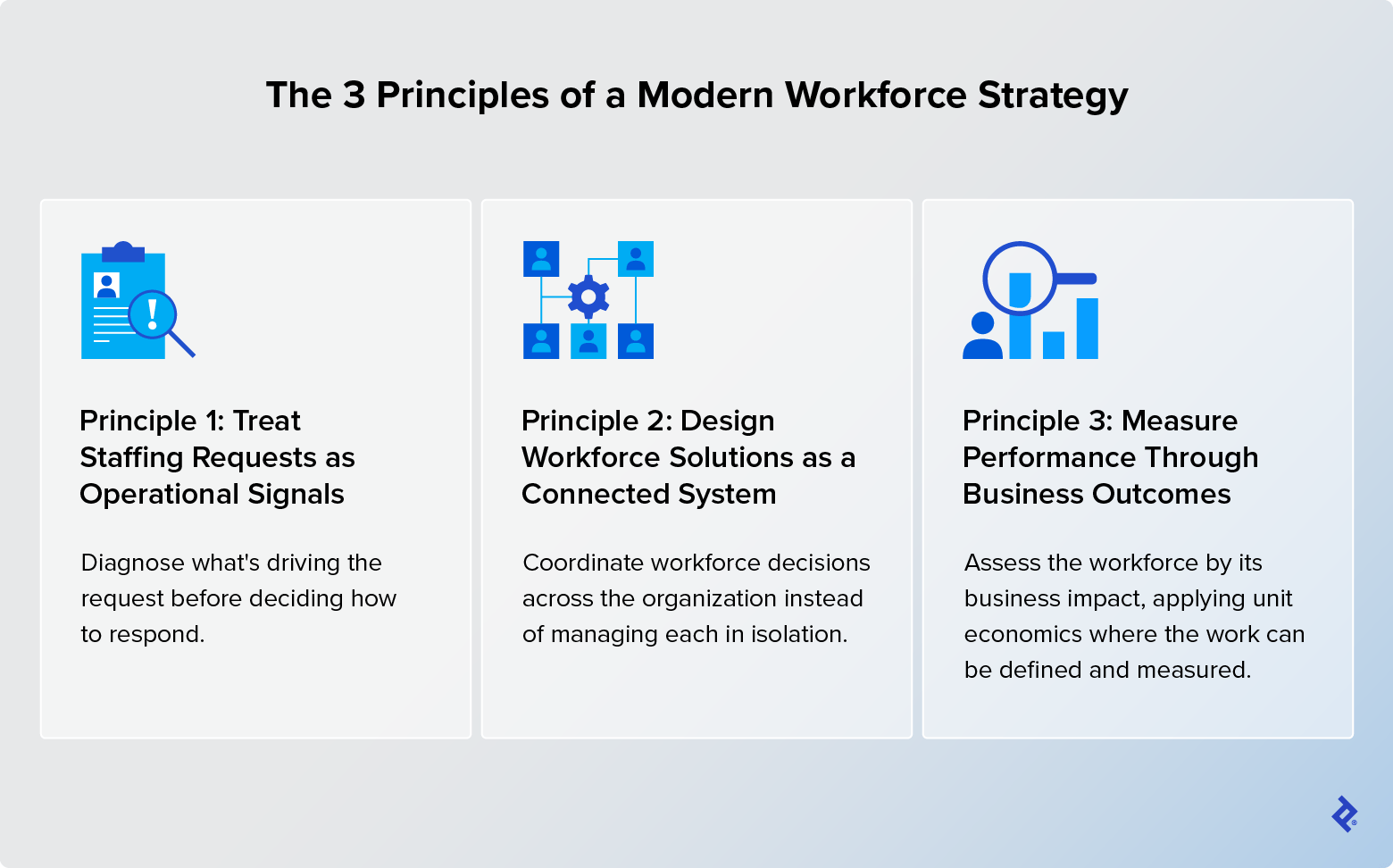
Each of these principles reinforces the others. Better diagnosis informs workforce decisions; integrated systems coordinate those decisions across staffing channels; and performance measurement provides the feedback needed to improve the strategy over time. Together, they transform workforce management from a series of routine, short-term staffing checks into a more deliberate, data-driven discipline.
Principle 1: Treat Staffing Requests as Operational Signals
When staffing demand is unexpected or persistent, leaders should diagnose what is driving it before deciding how to respond. The underlying cause may be a genuine shortage of people or skills, but it may also be a deeper operating constraint. While predictable demand created by seasonal needs, planned growth, or anticipated employee turnover can typically be addressed with a straightforward staffing response, recurring or sudden demand calls for closer examination.
Workforce forecasting and predictive analytics help leaders determine whether demand is temporary, recurring, or structural. Skills gap analysis then identifies whether the organization lacks the required capabilities or needs to deploy its existing workforce differently. Together, these tools point leaders toward the underlying cause, rather than relying on a default assumption that hiring will solve the problem.
Once the underlying need has been diagnosed, the next question is how the business should create the additional capacity. If an operation needs 20% more capacity, for example, that doesn’t necessarily mean adding 20% more permanent headcount. Other options include using temporary staffing, redeploying existing employees, building training programs or credentialing pathways, implementing agentic AI systems, or combining several approaches. The decision often depends on how long the additional demand is expected to last and whether the business needs to make a long-term workforce commitment or create capacity that can adjust as demand changes.
Takeaway
Diagnose what is driving the staffing request before deciding on the right workforce response. That diagnosis is what separates a workforce strategy that reacts to symptoms from one that solves the underlying problem.
Principle 2: Design Workforce Solutions as a Connected System
When staffing requests are managed one at a time without visibility into the broader workforce picture, organizations can miss patterns that repeat across roles, business functions, and locations. Based on conversations I have with staffing and procurement leaders at large companies and global organizations, the challenges are often structural: Workforce spend and oversight commonly sit scattered across staffing suppliers, contingent labor, direct sourcing, and other channels, each managed separately and evaluated against isolated metrics. This fragmentation makes it difficult to understand the full cost and performance of the workforce.
A workforce system replaces that fragmentation with a single, coordinated view of spend and performance, giving leaders a clearer picture of workforce utilization and whether increased investment is translating into higher business output. The system should be governed so that every workforce channel stays accountable to the same standards. The stakes of getting this right are significant. Staffing Industry Analysts’ 2026 Workforce Solutions Buyer Survey found that the share of contingent workforce programs reporting high ROI on contingent talent climbs from just 20% among the least mature programs to more than 70% among more advanced ones, with talent attraction and retention showing a similarly steep rise.
Designing an effective workforce system also requires treating strategic and operational workforce planning as complementary disciplines. Strategic planning sets the multiyear direction, identifying the capabilities the organization will need as the business evolves. Operational planning handles the shorter-term reality of meeting today’s requisitions and coverage needs. An organization that only plans operationally will remain reactive, and one that only plans long-term will risk losing touch with what’s happening on the ground.
With operational and strategic planning working through a single system, leaders can evaluate workforce demand and potential responses across the full enterprise rather than making decisions one request or channel at a time. Systems-level visibility also gives procurement teams a stronger basis for determining which workforce partners warrant deeper investment and which are simply adding complexity to the ecosystem.
Takeaway
Coordinate workforce solutions across the business instead of managing each need in isolation. Shared planning, visibility, and governance enable organizations to manage the full workforce system as a single effort.
Principle 3: Measure Workforce Performance Through Business Outcomes
Many organizations invest heavily in staffing and recruiting, but leaders tell me they struggle to determine whether that investment is improving output, quality, or cost. Staffing metrics such as time to fill, fill rate, attendance, and employee retention show whether an organization is successfully filling roles and maintaining its workforce. However, they do not, on their own, indicate whether the business itself is producing more or running better. A workforce can be fully staffed and stable while the operation continues to underperform.
Staffing and Workforce Performance Metrics | |
|---|---|
Dimension |
Example Metrics |
Speed |
Time to fill, time to submit |
Coverage |
Fill rate |
Stability |
Retention, attendance, turnover |
Conversion |
Temp-to-hire conversion, assignment completion |
Cost |
Bill rate, labor spend |
Two common measures illustrate this limitation. Time to fill shows how quickly an organization puts someone into a role, but it doesn’t show how quickly that person becomes productive. Similarly, for contingent labor, bill rate shows what an organization pays for a worker’s time but not necessarily the value that worker produces for the business. Someone with a lower bill rate may appear less expensive up front, but a more experienced professional with a higher bill rate may reach full productivity more quickly or produce higher-quality work that requires fewer corrections.
Connecting workforce performance to business outcomes provides a more complete picture of workforce effectiveness. Time to productivity, for example, shows how quickly a new worker begins contributing to the operation. When work can be clearly defined and counted, measures such as units completed and cost per completed unit show what the business is receiving for its investment. Tracking these measures alongside standard workforce analytics helps leaders answer questions traditional metrics cannot: Did backlog decline? Did cycle time improve? Did service levels hold? Did rework decrease? The answers may challenge conventional assumptions. A higher bill rate may ultimately result in lower per-unit costs, for example, while additional staffing may do little to reduce a persistent backlog of work.
Business Performance Metrics | |
|---|---|
Dimension |
Example Metrics
|
Output |
Units completed, orders fulfilled, claims resolved |
Efficiency |
Time to productivity, cycle time, cost per completed unit |
Quality |
Error rate, accuracy, rework |
Service |
SLA attainment, backlog reduction |
Putting unit-based metrics to work starts with defining a unit of work for the specific function. In claims processing, the unit might be a resolved claim. In logistics, it might be an order fulfilled. What matters is that the unit can be defined and counted, giving leaders a consistent way to measure performance against something the business actually produces. As organizations increasingly use AI agents as part of the workforce, unit-based measurement can also support workforce optimization by helping leaders assess how effectively work is structured and resourced, whether it’s done by people, AI agents, or some combination of the two.
Once work can be evaluated this way, organizations can also determine where outcome-oriented commercial models may make sense. Statement-of-work engagements, managed delivery, and cost-per-transaction arrangements can shift the commercial conversation from hours and headcount toward defined outputs and performance expectations. These models won’t suit every type of work, but unit economics gives leaders a clearer basis for determining where they do.
Takeaway
Connect workforce performance to what the business actually produces. Tying investment to a defined unit of business output gives leaders a clearer basis for evaluating decisions and identifying where outcome-based models make sense.
How to Implement a Modern Workforce Strategy
Most organizations already have an established workforce planning process. Modernizing the workforce strategy doesn’t necessarily require replacing that process. It means applying greater discipline throughout, ensuring that workforce decisions address the underlying operational need, are coordinated across the broader workforce system, and are consistently measured against business outcomes.
A typical implementation follows six steps:
- Align workforce strategy with business objectives, so the decision-making that follows is anchored to what the business is actually trying to achieve, instead of prioritizing whatever request happens to be loudest.
- Assess current workforce capabilities and the broader workforce ecosystem, including existing skills, capacity, talent pipelines, workforce channels, and the degree of fragmentation across workforce partnerships.
- Forecast workforce demand and identify capacity, capability, and workforce risks, grounding the response in specific, addressable problems rather than a general sense that more people are needed.
- Design an integrated workforce response, determining the right combination of talent, training, redeployment, agentic AI, and other technology to close the gaps identified.
- Deploy and govern the workforce system, establishing clear ownership, reporting, and performance expectations so that every workforce channel stays accountable to the same standards.
- Measure business outcomes and optimize accordingly, using measures such as productivity, quality, service levels, and cost per completed unit to determine whether workforce decisions are producing the intended results.
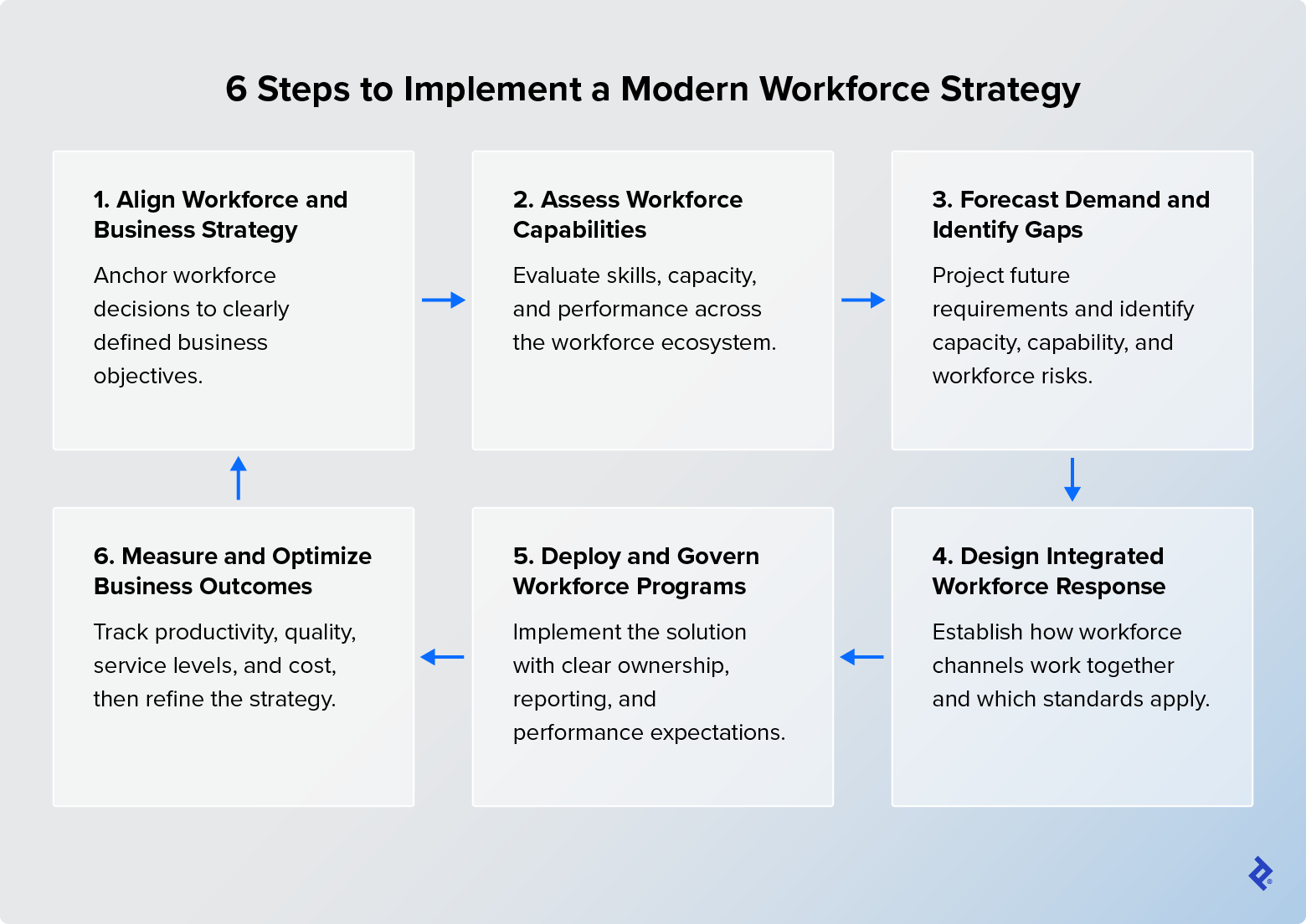
This process isn’t isolated to one business function. Workforce strategy touches on how HR builds capability, how procurement manages supplier relationships, how finance thinks about costs, and how operations experience the workforce day to day. A workforce strategy that lives inside a single function, without shared ownership and executive sponsorship, is likely to stall as soon as it encounters a problem that’s outside of that team’s control.
Building the Right Workforce Ecosystem
Workforce fragmentation is one of the most common obstacles I see in large organizations. Enterprises often spread workforce spend across numerous staffing providers, contingent workforce channels, direct sourcing programs, and specialized partners. When those relationships operate independently, coordination can easily break down, and the burden of understanding how workforce demand and performance connect to business priorities falls back on the organization.
Building the right workforce ecosystem requires a model that closes the context gap on all sides of these relationships. External partners need sufficient visibility into workforce needs and business priorities to contribute beyond individual requisitions. Driving long-term workforce transformation also requires internal alignment, with HR, procurement, finance, operations, and business leadership teams working from the same priorities and performance measures rather than each operating from a partial view.
The goal isn’t consolidation for its own sake. A more integrated workforce ecosystem provides strategic partners with the context to understand demand patterns, operating priorities, and performance expectations. Instead of waiting for the next requisition, they can spot a recurring need before it becomes one and work with internal teams on the right orchestration of work across people and technology.
What to Look for in Strategic Workforce Partners
Not every workforce partner is built to support this kind of future-ready workforce ecosystem. Here are several questions I recommend asking when evaluating staffing partners:
- Does the partner bring curated, quality-vetted talent and disciplined execution? Look for consistent intake processes, high-quality submissions, careful onboarding, and strong retention. Talent supply and fulfillment speed matter, especially for critical roles, but they shouldn’t come at the expense of quality or consistency.
- Does the partner provide visibility into its own performance? Requisition activity, compliance, service levels, and results should be trackable against clear standards, supported by supplier scorecards and defined escalation paths rather than left for the organization to piece together after the fact.
- Does the partner invest in workforce planning and capability building? In constrained labor categories, in particular, effective partners should help anticipate future workforce needs and invest in training pathways, credentialing, and regional talent development rather than simply drawing from the available talent pool.
- Does the partner take clear responsibility for compliance and risk? Strong partners should understand their responsibilities for workforce classification, compliance, and operational risk, with clear ownership and escalation processes rather than leaving responsibilities ambiguous.
- Can the partner demonstrate outcomes that go beyond fulfillment metrics? Time to fill and fill rate still matter, but quality, productivity, ramp to productivity, and service levels are what actually show whether the partnership can deliver genuine workforce ROI.
- Does the partner have a proven AI-enabled workforce system? AI is increasingly built into sourcing, screening, and workforce planning, but using AI isn’t the same as proving it works. The strongest partners can provide measurable results showing whether their systems hold up at scale and actually improve the precision and quality of work, not just fulfillment speed.
In my experience, these criteria all point in the same direction: fewer, better partners, chosen deliberately rather than accumulated over time. The goal is to build enough depth into each relationship that partners understand the business, share accountability for performance, and contribute beyond individual requisitions.
The Future of Workforce Strategy Is Business Performance
An organization that still manages workforce decisions as a series of transactions, one requisition, one role, one hire at a time, will keep solving the same problems without addressing what’s actually causing them. While established workforce management disciplines shouldn’t be rejected, an effective workforce strategy requires connecting them through a coordinated system. Within that system, what matters most is whether the organization’s partners can turn demand data into real intelligence, build relationships deep enough to understand the business as a whole, and measure performance by the outcomes the workforce actually produces.
Have a question for Josh or his Staffing Solutions team? Get in touch.


